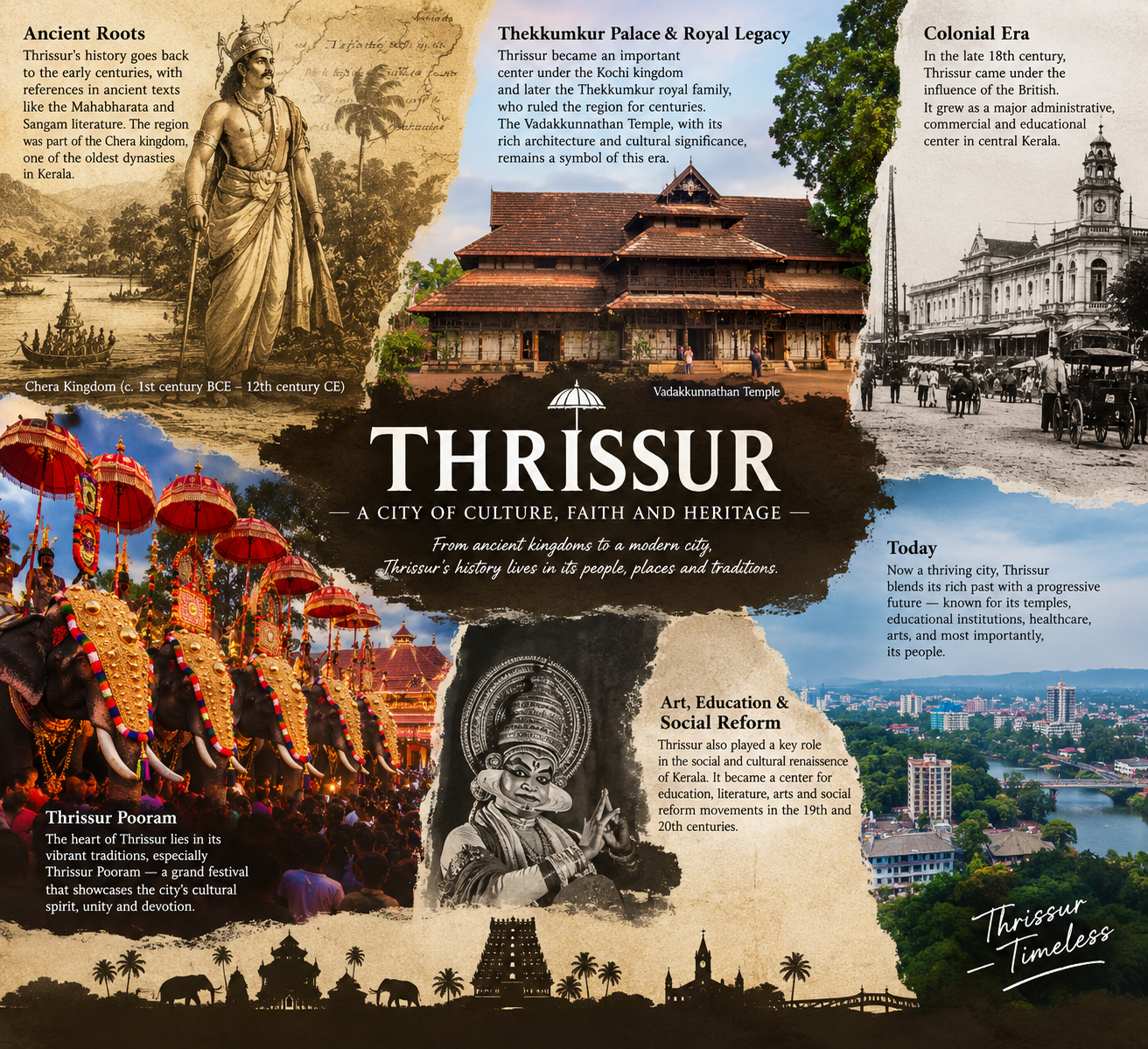
Thrissur: A City of Heritage
It was during the reign of Shakthan Thampuran that Thrissur took shape. Among all those who introduced reforms in Thrissur and proposed alternative paths for its future development, the ruler of Kochi, Shakthan Thampuran, occupies the foremost position. He was also the person who initiated the transformation of Thekkinkadu, the very lungs of Thrissur.
Although many changes were introduced later, it was Shakthan Thampuran who transformed Thekkinkadu from a dense teak forest into a temple ground and eventually into the present festival ground. According to local tradition, when the oracle of the Paramekkavu Bhagavathy Temple strongly opposed the project, the king remained undeterred and proceeded with his plans. He also abolished several older practices related to punishment and social control. It was Shakthan Thampuran who transformed the forest into a temple precinct and later into the venue of the famous Thrissur Pooram.
The internationally renowned Thrissur Pooram was also his creation. Whether he formally transferred the festival from Arattupuzha or simply brought together groups that had withdrawn from that celebration, he succeeded in establishing it as an annual festival in Thrissur. He was responsible for creating Thrissur Pooram and for spreading the fame and prestige of the city. It is also said that he encouraged a healthy rivalry between the people of Paramekkavu and Thiruvambady, which later became one of the defining features of the festival. Over time, that competition became so intense that government regulations had to be introduced to control it.
To promote the textile trade, Shakthan Thampuran invited Brahmins from the Pandya region and established government-funded feeding centers at Pattikkad, Cheruthuruthy, and Thrissur for their convenience. To encourage trade and industry, he also provided settlement facilities for certain Syrian Christian families and established free monasteries and residences for the Brahmins who had migrated from the neighboring regions. The market area of Thrissur and the Pandi Samooham Mutt developed as a result of these measures.
Even before receiving complete political authority, Shakthan Thampuran entered state administration with the approval of influential groups and with the support of the Western powers of that period. He was regarded as a highly capable, courageous, and wise ruler.
After the Zamorin and his army withdrew from Thrissur, Shakthan Thampuran assumed power. Many powerful Namboothiri families who had supported the Zamorin fled the region out of fear. Only a few remained. The treasury of the Vadakkunnathan Temple came under government control, and the authority and privileges of the Namboothiris disappeared. Even the Yogathiri, who held significant influence at the time, fled and never returned to Thrissur. As a result, the Vadakkunnathan Temple, the most important institution in Thrissur, became a government-controlled temple. Shakthan Thampuran was responsible for introducing this administrative system, after which he began the reorganization of Thekkinkadu.
Since many Namboothiris had supported the Zamorin, Shakthan Thampuran believed that they could not be fully trusted. Therefore, he brought qualified people from other regions to perform temple duties. Priests were invited from Kurumbranad, while temple functionaries were brought from areas near Thalassery. He fixed their qualifications, responsibilities, and salaries.
In earlier times, Thrissur had two royal residences and three ponds. The southern palace was known as the Erattachira Kovilakam, while the northern palace became what is now known as the Old Kovilakam. The rulers of Kochi resided in the northern palace, while members of the Perumpadappu royal family stayed in the southern palace.
During the early years of Shakthan Thampuran's rule, leadership positions within the royal family underwent significant changes. The old system gradually disappeared, and all authority eventually became centralized under the ruler of Kochi. The transformation of the city's landscape, including the construction of new roads and the modification of water bodies, also took place during this period.
The Ashokeswaram Temple, which belonged to the royal palace, was one of the places where Shakthan Thampuran regularly stayed. He also frequently visited the residence of one of his close friends, known as Tharakan.
For these reasons, Shakthan Thampuran is widely regarded as the architect of modern Thrissur.
There is a story that he once severely punished a temple priest for negligence. He also renovated the palace previously occupied by the Zamorin and constructed fortifications and defensive structures around it. Historical records indicate that disagreements with the British arose during these construction projects, but he ultimately completed the work.
Shakthan Thampuran died in the northern section of the palace's second floor. He was cremated at an elevated site between the palace and the Ashokeswaram Temple. That location is still preserved as a place of historical significance.
The traditional palace ceremonies associated with Thrissur Pooram were also introduced by him. During his reign, the Kingdom of Kochi was divided into northern and southern administrative divisions, with Thrissur serving as the headquarters of the northern division. Later, an eastern division was also established.
The title "Shakthan" (the powerful one) was not merely honorary. Neighboring rulers also recognized his strength and authority. At the same time, he was known for his generosity and compassion. During his reign, incidents of violence and dishonesty were reportedly much less common.
Thrissur was an important commercial center during his rule. It was also during this period that the invasions of Hyder Ali and later Tipu Sultan affected Malabar. Shakthan Thampuran recognized that it was impossible for Kochi to confront Mysore militarily. Therefore, he adopted a diplomatic approach and aligned himself strategically.
Even when many kingdoms, including that of the Zamorin, disappeared under British expansion, the Kingdom of Kochi survived. This survival is often attributed to the foresight and political wisdom of Shakthan Thampuran.
It is also remembered that his mother, Nethyaramma, was Chimmukkutty of Vadakke Karimpatta in Thrissur.
Shakthan Thampuran was the founder, protector, and chief developer of Thrissur. During his reign, the Brahmin family known as the Maliyekkal Karthakkal possessed judicial authority, including the power to impose capital punishment. Executions were reportedly carried out at a place called Arakkamthuruth.
Fortifications and defensive trenches were constructed around 1700 to protect the region from military threats. Shakthan Thampuran is also said to have watched military exercises and ceremonial displays from these fortifications.
According to the Survey Settlement Register of 1084 M.E. (Malayalam Era), Thrissur officially emerged as a town during this period. Peringavu, Chiyyaram, and Ollukkara formed its boundaries.
In every sense, Shakthan Thampuran remains the creator and visionary behind modern Thrissur.